
Salon PRA POS Software in Pakistan: What Salon Owners Actually Need to Know
It’s a Saturday evening. Every chair in the salon is full, three clients are waiting on the sofa, and the receptionist is juggling a paper appointment diary, a calculator, and a stack of loose receipts. Somewhere in that chaos, a client’s tax invoice either doesn’t get generated correctly or doesn’t get generated at all. Multiply that by every busy weekend of the year, and it’s easy to see why so many salons in Punjab end up on the wrong side of a Punjab Revenue Authority (PRA) notice: not because they were trying to avoid tax, but because their billing system was never built to handle it.
That’s the real story behind the growing demand for salon PRA POS software in Pakistan. It isn’t a niche compliance request anymore; it’s become one of the first questions salon owners ask before buying any system at all.
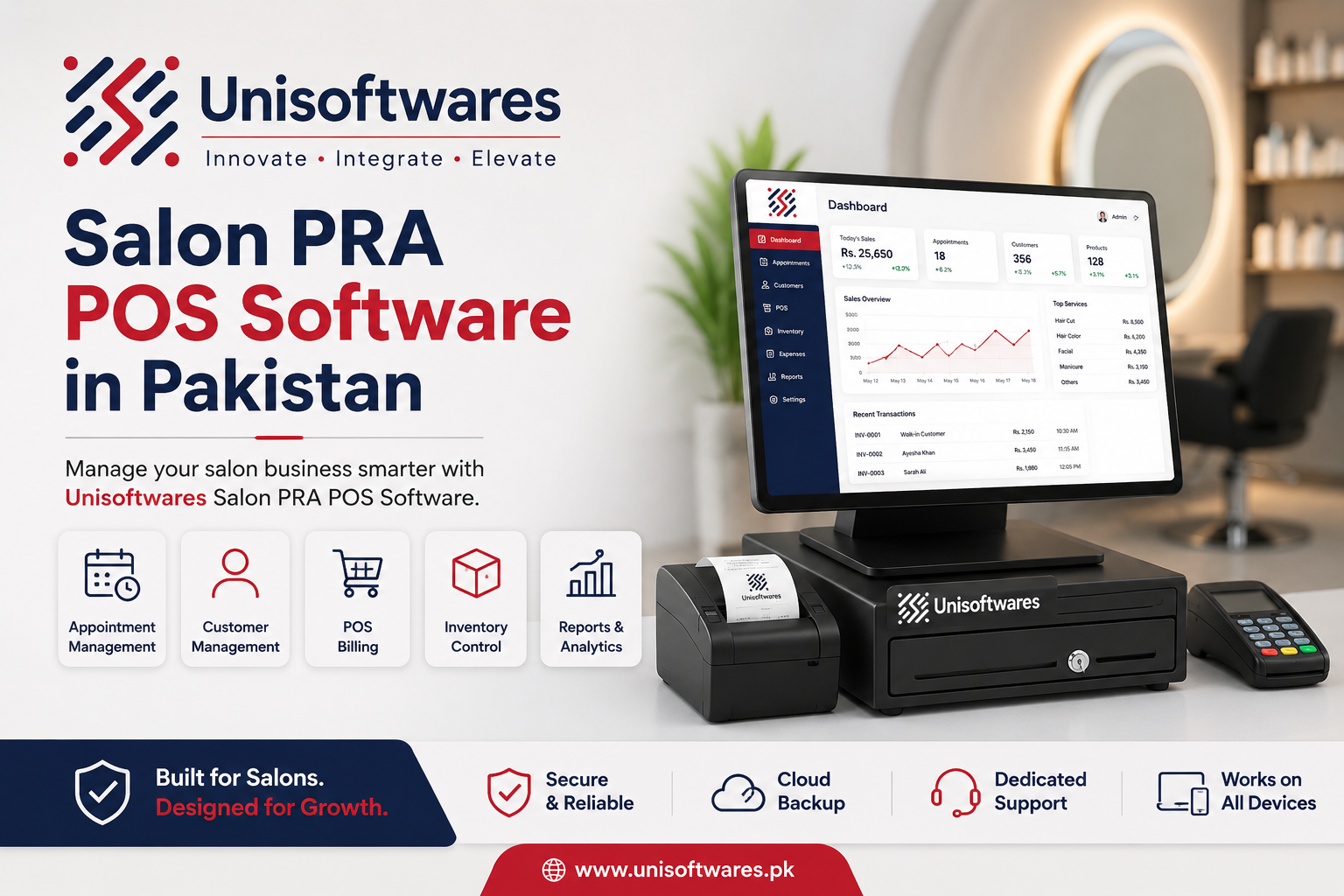
The Salon Business Isn’t Like a Retail Counter, and That’s the Problem
Most POS software sold in Pakistan was originally designed for retail shops: scan a barcode, ring up an item, and print a receipt. A salon doesn’t work that way. A single client visit might combine a haircut, a keratin treatment, retail hair products, and a package deal booked two weeks in advance, each with different pricing logic, different staff commissions attached, and, for PRA purposes, a tax treatment that needs to be applied correctly and reported instantly.
When salon owners try to force this kind of business into a generic retail POS, three things usually go wrong:
- Tax gets calculated inconsistently. Service-based billing, package pricing, and product sales all need to route through the same tax logic, and generic systems weren’t built with that flexibility.
- Invoices don’t carry a valid PRA reference. A receipt that looks fine to the customer can still fail an audit if it isn’t tied to a proper, verifiable tax invoice number issued through PRA’s system.
- Reporting becomes a manual chore. Owners end up exporting spreadsheets and reconciling them against PRA’s portal by hand at month-end, exactly the kind of error-prone process a POS system was supposed to eliminate.
Unisoftwares Pakistan built its salon management software to solve this from the ground up, treating PRA compliance as a core requirement of salon billing rather than a feature squeezed in afterward.
Why PRA Compliance Applies to Salons in the First Place
The Punjab Revenue Authority taxes services, and salons, beauty parlors, spas, and grooming studios fall directly under that category. Once a salon’s annual turnover crosses PRA’s prescribed threshold for service providers, integrating its point-of-sale system with PRA stops being optional. The logic is straightforward: PRA wants real-time visibility into service sales so tax collection reflects what’s actually happening at the counter, rather than relying on end-of-year self-reporting that’s easy to under-declare.
For a salon owner, this changes what “billing software” even means. It’s no longer just a tool to print a receipt; it’s the system responsible for calculating the correct tax on every service and product sold, generating a verifiable invoice, and transmitting that data to PRA the moment the sale happens.
Skipping this isn’t a minor risk. Salons operating above the threshold without integration can face financial penalties, legal action, and, in serious cases, suspension of business activity, a far costlier outcome than the modest cost of proper software.
Generic POS vs. Salon PRA POS: A Side-by-Side Look
This is the gap that matters most when salon owners compare “any POS with a tax module” against software actually designed around how a salon runs day to day.
| What You Need | Generic Retail POS | Unisoftwares Pakistan Salon PRA POS |
| Service-based billing (haircuts, treatments, packages) | Limited or manual workaround | Built-in, with per-service pricing and combo/package rates |
| Real-time PRA invoice reporting | Usually absent or bolted on | Native, automatic on every checkout |
| Staff commission tracking | Not designed for it | Tracked automatically per service and staff member |
| Appointment-linked billing | Disconnected from scheduling | Booking and billing share one record |
| Offline billing during power cuts | Often stops working entirely | Continues billing offline, syncs to PRA once reconnected |
| Product + service tax handling in one invoice | Requires manual splitting | Automatically applied within a single invoice |
What a Genuinely PRA-Ready Salon System Looks Like in Practice
At the checkout counter: Client who got a haircut and a hair spa treatment and bought a bottle of retail shampoo checks out at the checkout counter in one transaction. The system applies the correct tax treatment to each line item, generates a single invoice with a valid PRA reference number, and prints or shares it instantly.
Behind the scenes: Every transaction is logged and transmitted to PRA in real time. There’s no batch upload at the end of the day and no risk of a forgotten invoice slipping through unreported.
During a power outage: Billing continues offline. Once the connection returns, every pending invoice, including the PRA submission data, syncs automatically, so there’s no gap in the compliance record even during Punjab’s frequent load-shedding.
At month-end: Instead of reconciling spreadsheets against a tax portal, the owner opens a single dashboard showing exactly what was billed, what tax was collected, and what’s been reported.
Beyond Compliance: The Operational Side of Salon Software
Tax integration solves a legal problem, but it doesn’t run your salon. Unisoftwares Pakistan’ platform pairs PRA compliance with the operational tools salon owners actually spend their day using:
- Appointment scheduling that prevents double-booking and syncs with front-desk billing automatically, so a booked service becomes a checkout without re-entering anything.
- Customer profiles that store service history, product preferences, and visit frequency, so staff can personalize recommendations and owners can run loyalty offers for repeat clients.
- Staff commission tracking, calculated automatically per service performed, removing the disputes that come from manual commission sheets.
- Inventory control for retail products and in-treatment supplies, with low-stock alerts so a stylist never runs out of color or product mid-treatment.
- Multi-branch reporting, useful for salon chains operating across more than one city or neighborhood, consolidating sales, tax, and staff performance into one view.
- Role-based access, so front-desk staff, stylists, and management each see only what they need to, protecting sensitive billing and customer data.
Common Misconceptions Salon Owners Have About PRA Integration
“My salon is too small to need this.”
Threshold rules are based on annual turnover, not the number of chairs in your salon. A small, busy salon can cross the threshold faster than expected, especially once retail product sales are added in.
“I can just file everything manually at year-end.”
PRA’s requirement is for real-time invoice reporting, not annual self-declaration. Manual, after-the-fact filing doesn’t meet the compliance standard and leaves no defensible audit trail.
“Any POS with a ‘tax’ checkbox counts as PRA integration.”
A tax rate applied at checkout is not the same as a verified, real-time submission to PRA carrying a valid invoice reference. Many systems marketed as “tax-ready” only handle the calculation, not the actual reporting connection.
“Switching systems will disrupt my bookings and client records.”
A proper onboarding process migrates existing client and appointment data rather than starting from zero, so the transition doesn’t mean losing years of customer history.
Who This Is Built For
Unisoftwares Pakistan’s salon PRA POS software fits single-location beauty parlors just as well as multi-branch salon chains, hair studios, spas, and grooming lounges across Punjab’s major cities. Whether it’s a neighborhood parlor booking a dozen appointments a day or a multi-chair salon running back-to-back services on weekends, the same core system, booking, billing, commission tracking, and PRA reporting, scales to fit.
Making the Switch
Moving to a PRA-integrated salon system typically involves three steps: configuring services, staff, and pricing; verifying PRA registration details against the software; and a short training session for front-desk and stylist teams. Existing client records and appointment history are migrated rather than discarded, so the salon doesn’t lose the relationship data it’s built over time. Most salons in Punjab are fully operational on the new system within a matter of days.
Questions Salon Owners Ask Before Switching
Do all salons in Pakistan need PRA integration, or just the big ones?
It depends on annual turnover crossing PRA’s prescribed threshold for service providers. Once a salon crosses that line, integration becomes a legal requirement rather than a choice, and it’s worth adopting early rather than waiting for a notice.
What actually counts as “PRA integration,” beyond just calculating tax?
Real integration means the system generates a verifiable invoice with a valid PRA reference and transmits that sales data to PRA in real time.
Will I lose my client records if I switch systems?
No. A proper onboarding process migrates existing customer profiles, service history, and appointment data instead of starting fresh.
Can the system handle both service billing and retail product sales together?
Yes, a single client checkout can combine services, packages, and retail products, with the correct tax treatment applied automatically to each.
What happens to billing during a power outage?
Billing continues offline, and every transaction, including PRA-related invoice data, syncs automatically once the connection is restored.
Is this only useful for large salon chains, or does it make sense for a single small salon too?
It works for both. A single-location salon gets the same billing accuracy and compliance protection as a multi-branch chain, just without the multi-branch dashboard features it doesn’t need yet.
How long does setup usually take?
Most salons are fully onboarded, including staff training and PRA verification, within a few days.
Does staff commission tracking work automatically, or does someone need to calculate it manually?
Commissions are calculated automatically based on the services each staff member performs, removing the need for manual commission sheets.
